


Why Energy Labels Don't Tell the Whole Story About Wine Cabinets
Energy efficiency is important—but when it comes to storing valuable wines, it is only one part of the equation. Discover why premium wine cabinets have different technical requirements than household refrigerators and why professional wine preservation demands far more than simply achieving the lowest possible energy consumption.
Many customers are surprised when they compare the European energy labels of wine cabinets with those of conventional refrigerators. While modern refrigerators often achieve energy classes A, B or C, many premium wine cabinets are rated lower.
At first glance this may appear to indicate that a wine cabinet is less efficient. In reality, however, these products have entirely different purposes and are engineered around completely different priorities.
A refrigerator is designed to cool food efficiently for everyday consumption. A premium wine cabinet, on the other hand, is engineered to preserve valuable wines over many years while creating the stable cellar conditions required for proper maturation.
An energy label measures electricity consumption under standardized laboratory conditions. It does not measure how effectively a wine cabinet protects your wine, preserves aromas, minimizes vibration, shields bottles from UV radiation or maintains ideal ageing conditions over many years.
Contents
- Why refrigerators and wine cabinets cannot be compared
- How glass doors influence energy consumption
- The importance of temperature stability
- Why dual-zone wine cabinets require more energy
- The role of inverter compressors
- Air circulation and humidity management
- Which technologies are not reflected in the EU energy label?
- Choosing the right wine cabinet
Different Products. Different Priorities.
Although both appliances use refrigeration technology, a refrigerator and a wine cabinet are built to solve completely different challenges.
A household refrigerator focuses primarily on keeping food cold while minimizing electricity consumption. Temperature fluctuations caused by frequent door openings are generally acceptable because food products are intended to be consumed within days or weeks.
Wine behaves very differently.
Fine wines may remain inside the cabinet for years—or even decades. During this time they continue to evolve chemically. Even small temperature fluctuations, excessive vibration or ultraviolet light can negatively influence the ageing process and ultimately affect aroma, structure and complexity.
For this reason, premium wine cabinets are designed around one objective above all else:
Perfect Long-Term Storage
A professional wine cabinet aims to recreate the stable conditions traditionally found in natural underground wine cellars:
- Consistent temperatures throughout the year
- Minimal temperature fluctuations
- Protection from UV radiation
- Low vibration levels
- Controlled air circulation
- Suitable humidity conditions
Every one of these functions contributes to protecting your wine—but many also require additional technology and therefore additional energy.
Why Comparing a Refrigerator to a Wine Cabinet Can Be Misleading
| Household Refrigerator | Premium Wine Cabinet |
|---|---|
| Stores food for everyday use | Protects wines for years or decades |
| Optimized primarily for energy efficiency | Optimized primarily for stable ageing conditions |
| Usually features insulated solid doors | Often features insulated UV-protective glass doors |
| Single cooling zone | One or two independently controlled climate zones |
| Wide temperature tolerance | Very high temperature precision |
| Humidity plays little role | Humidity contributes to cork protection |
| Food stored for days or weeks | Wine stored for many years |
Rather than asking "Which appliance uses less electricity?", wine enthusiasts should ask:
Why Glass Doors Naturally Require More Energy
One of the biggest differences between a refrigerator and a premium wine cabinet is immediately visible: the door.
Most household refrigerators use highly insulated solid doors. Their primary objective is simple—keep the cold air inside while minimizing energy consumption.
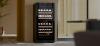
Wine cabinets, however, are designed to showcase a carefully curated wine collection while simultaneously protecting it from harmful environmental influences. This is why premium wine cabinets typically feature large insulated glass doors instead of opaque metal panels.
Although modern wine cabinet glass incorporates sophisticated insulation technologies, glass can never provide the same thermal insulation as a thick insulated solid door. More heat enters the cabinet through glass than through insulated metal, requiring the cooling system to work harder to maintain perfectly stable temperatures.
Premium Glass Technology
Modern wine cabinet doors are far more advanced than ordinary window glass. Depending on the model, premium manufacturers integrate technologies such as:
- Triple-pane insulated safety glass
- Argon gas insulation between glass layers
- UV-protective coatings
- Low-emissivity (Low-E) coatings to reduce heat transfer
- Thermally optimized aluminium door frames
These technologies significantly reduce heat transfer while protecting valuable wines from damaging ultraviolet radiation.
Temperature Stability Is More Important Than Low Energy Consumption
For wine, maintaining the correct temperature is only part of the equation. Equally important is maintaining that temperature consistently over many years.
Frequent fluctuations accelerate the ageing process and may negatively affect aroma, balance and long-term development. For collectors storing valuable wines, stability often matters more than reaching a specific storage temperature.
Premium wine cabinets therefore use highly sensitive electronic controls capable of maintaining temperatures within a very narrow operating range.
Whenever the ambient temperature changes, the cabinet continuously adjusts compressor speed and cooling output to keep conditions as stable as possible.
A stable 12°C environment is considerably more beneficial than temperatures continuously fluctuating between 9°C and 15°C.
Why Dual-Zone Wine Cabinets Consume More Energy
Many premium wine cabinets feature two independently controlled temperature zones.
This allows red wines and white wines to be stored simultaneously at their ideal serving or ageing temperatures inside the same appliance.
Creating two separate climate zones inside one insulated cabinet is technically demanding. Each zone requires continuous monitoring, precise airflow management and careful balancing between the upper and lower compartments.
Naturally, this additional level of climate control requires more sophisticated engineering—and slightly higher energy consumption.
| Single-Zone Cabinet | Dual-Zone Cabinet |
|---|---|
| One temperature throughout | Two independently controlled climates |
| Simpler airflow management | Continuous balancing between zones |
| Lower control complexity | Higher electronic precision |
| Lower energy demand | Slightly higher energy demand |
Inverter Compressors: Efficient Through Intelligent Control
Modern premium wine cabinets increasingly rely on inverter compressor technology.
Unlike conventional compressors that repeatedly switch fully on and off, inverter compressors continuously adjust their speed according to actual cooling demand.
This intelligent operation offers several advantages:
- Lower energy consumption during normal operation
- Improved temperature stability
- Reduced mechanical wear
- Longer compressor lifespan
- Lower operating noise
- Reduced vibration
Although inverter technology improves efficiency significantly, it cannot fully compensate for the additional energy required by insulated glass doors, precise climate control and professional wine preservation.
Air Circulation: An Invisible Yet Essential Technology
Professional wine storage depends on much more than cooling alone.
Cold air must be distributed evenly throughout the cabinet to prevent warm and cold spots. Premium wine cabinets therefore employ carefully engineered air circulation systems that continuously move air through the interior.
The objective is to ensure that every bottle experiences nearly identical storage conditions, regardless of its position inside the cabinet.
The circulation fans consume only a small amount of electricity, yet they play a crucial role in maintaining consistent ageing conditions throughout the appliance.
Humidity Helps Protect Natural Corks
Natural cork remains one of the most widely used wine closures for premium wines intended for long-term ageing.
If storage conditions become excessively dry over many years, corks may gradually lose elasticity, potentially allowing unwanted air exchange between the bottle and its surroundings.
For this reason, premium wine cabinets are designed to maintain suitable humidity conditions alongside precise temperature control.
Rather than actively drying the interior like many refrigerators, wine cabinets aim to create a balanced storage environment that supports both the wine and its closure.
Every Technology Has an Energy Cost
Every premium feature inside a wine cabinet contributes to better protection of valuable wines—but each also requires additional engineering and, to some extent, additional energy.
| Technology | Benefit for Wine | Impact on Energy Consumption |
|---|---|---|
| UV-protective insulated glass door | Protects wine from harmful light | Higher |
| Dual-zone climate control | Different temperatures for different wines | Higher |
| Precision electronic regulation | Excellent temperature stability | Slightly higher |
| Continuous air circulation | Uniform climate throughout the cabinet | Minimal |
| Inverter compressor | Greater efficiency and stability | Reduces overall consumption |
What the EU Energy Label Does Not Measure
The EU energy label is designed to provide consumers with a standardized way to compare the energy consumption of appliances.
This is useful—but it is important to understand what the label actually evaluates and what it leaves out.
The energy label does not assess:
- Temperature stability over long periods
- Protection from ultraviolet radiation
- Vibration reduction
- Humidity conditions
- Airflow quality
- Noise characteristics
- Quality of shelves and interior materials
- Long-term durability
- Suitability for wine ageing
In other words, the label measures how much electricity an appliance uses under defined test conditions. It does not measure how effectively that appliance protects a valuable wine collection.
Energy Efficiency and Wine Protection Are Not Opposites
A high-quality wine cabinet should be engineered to achieve the best possible balance between low energy consumption and optimal storage conditions.
The objective is not to consume more energy than necessary. The objective is to avoid sacrificing wine protection simply to achieve a better letter on the label.
Why the New Energy Scale Can Be Misleading
The current European energy scale is considerably stricter than previous labelling systems.
Appliances that were once classified in the upper range of the old scale may now appear in classes F or G, even though their actual energy consumption has not suddenly increased.
The revised scale was intentionally designed with room for future technological development. This means that the highest classes are difficult to achieve and, in some appliance categories, remain largely unoccupied.
It often reflects a stricter classification system and the specific technical demands of the appliance category.
Annual Consumption Matters More Than the Letter Alone
When comparing wine cabinets, customers should look beyond the energy class and examine the actual annual energy consumption stated in kilowatt-hours.
Two appliances in the same energy class can still have noticeably different annual consumption figures. Cabinet size, bottle capacity, number of zones, type of door and ambient installation conditions all influence the result.
A larger cabinet may consume more electricity overall while storing significantly more bottles. In this case, the energy consumption per stored bottle may be lower than that of a smaller unit.
| Comparison Criterion | Why It Matters |
|---|---|
| Annual consumption in kWh | Shows the estimated yearly electricity demand |
| Bottle capacity | Provides context for the appliance size |
| Number of temperature zones | Indicates the complexity of climate control |
| Glass or solid door | Strongly influences insulation performance |
| Installation type | Built-in and freestanding models have different ventilation requirements |
| Ambient room temperature | Higher surroundings increase cooling demand |
The Importance of Correct Installation
Even the most efficient wine cabinet can consume more energy than necessary if it is installed incorrectly.
Built-in and under-counter models require sufficient ventilation so that heat generated by the cooling system can escape efficiently.
Blocked ventilation openings, inadequate niche dimensions or installation close to heat sources may cause the compressor to run more frequently.
For optimal performance, the following points should always be considered:
- Follow the specified niche dimensions
- Maintain the required ventilation openings
- Keep the appliance away from ovens and radiators where possible
- Avoid direct sunlight
- Ensure that the door closes correctly
- Do not block internal air circulation
- Allow the appliance to acclimatize before initial operation
How SWISSCAVE Approaches Energy Efficiency
At SWISSCAVE, energy efficiency is an important part of product development—but never in isolation.
Every new generation of wine cabinets is developed with the objective of reducing energy consumption wherever technically possible while maintaining the storage conditions required for valuable wines.
This includes the continued development of:
- Energy-efficient inverter compressors
- Improved insulation systems
- Optimized air circulation
- Intelligent electronic controls
- Low-consumption LED lighting
- Efficient fan technology
- Thermally optimized glass doors
The challenge is to improve efficiency without compromising temperature stability, humidity conditions, UV protection, vibration control or product durability.
Continuous Improvement Without Compromise
SWISSCAVE continuously works to make each product generation more efficient.
However, the central purpose of a wine cabinet remains unchanged: to protect wine and provide reliable storage conditions over many years.
How to Choose the Right Wine Cabinet
The energy label should form part of your decision—but it should never be the only criterion.
Before purchasing a wine cabinet, consider the following questions:
- Do you want to store wine for ageing, serving or both?
- Do you require one or two temperature zones?
- How many bottles do you plan to store in the future?
- Will the cabinet be built in, installed under a counter or used freestanding?
- Is UV protection important for the installation location?
- Are low noise and low vibration important?
- Does the cabinet provide suitable conditions for natural corks?
- Are the shelves designed for different bottle shapes?
- Is service and spare-part availability ensured?
A wine cabinet is a long-term investment. The quality of the storage environment may be considerably more valuable than a small difference in annual electricity costs.
Conclusion: Look Beyond the Energy Class
Energy consumption matters. Responsible manufacturers should continuously work to reduce it.
But a wine cabinet cannot be evaluated in the same way as a conventional refrigerator.
Glass doors, multiple temperature zones, precise electronic regulation, continuous air circulation, UV protection, humidity management and vibration reduction all contribute to creating a stable environment for wine.
These technologies may influence the energy rating—but they also determine how well your wine is protected.
It is the appliance that combines responsible energy consumption with stable temperature, suitable humidity, UV protection, low vibration and reliable long-term performance.
Frequently Asked Questions
Why do many wine cabinets have energy class G?
The current EU energy scale is much stricter than the previous system. Wine cabinets also use glass doors, precise climate control and, in many cases, multiple temperature zones. These technical requirements naturally affect their classification.
Does energy class G mean that a wine cabinet is inefficient?
Not necessarily. The energy class must always be considered together with annual consumption, appliance size, bottle capacity, number of zones and door construction. A lower class does not automatically indicate poor technology.
Why does a glass door consume more energy?
Even high-quality insulated glass transfers more heat than a thick solid door. The cooling system must therefore compensate for the additional heat entering the cabinet.
Are dual-zone wine cabinets less efficient?
They generally require slightly more energy because two separate temperature areas must be monitored and controlled. In return, they offer significantly greater flexibility for storing and tempering different wines.
Should I choose a wine cabinet based on energy class alone?
No. Temperature stability, UV protection, vibration control, humidity, storage capacity, noise level, shelf design, installation requirements and service quality are equally important.
Can correct installation reduce energy consumption?
Yes. Adequate ventilation, correct niche dimensions, sufficient distance from heat sources and an unobstructed airflow help the appliance operate efficiently.
Do inverter compressors improve efficiency?
Yes. Inverter compressors adapt their speed to actual cooling demand. This can reduce energy use, improve temperature stability and lower noise and vibration.
Discover SWISSCAVE Wine Cabinets
Explore wine cabinets developed for precise temperature control, long-term wine storage and seamless integration into modern interiors.
Whether you are looking for a compact under-counter model, an integrated kitchen solution or a large freestanding wine cabinet, SWISSCAVE offers solutions for both private collectors and professional environments.
Find the wine cabinet that fits your collection, your space and your storage requirements.
<







Comments